
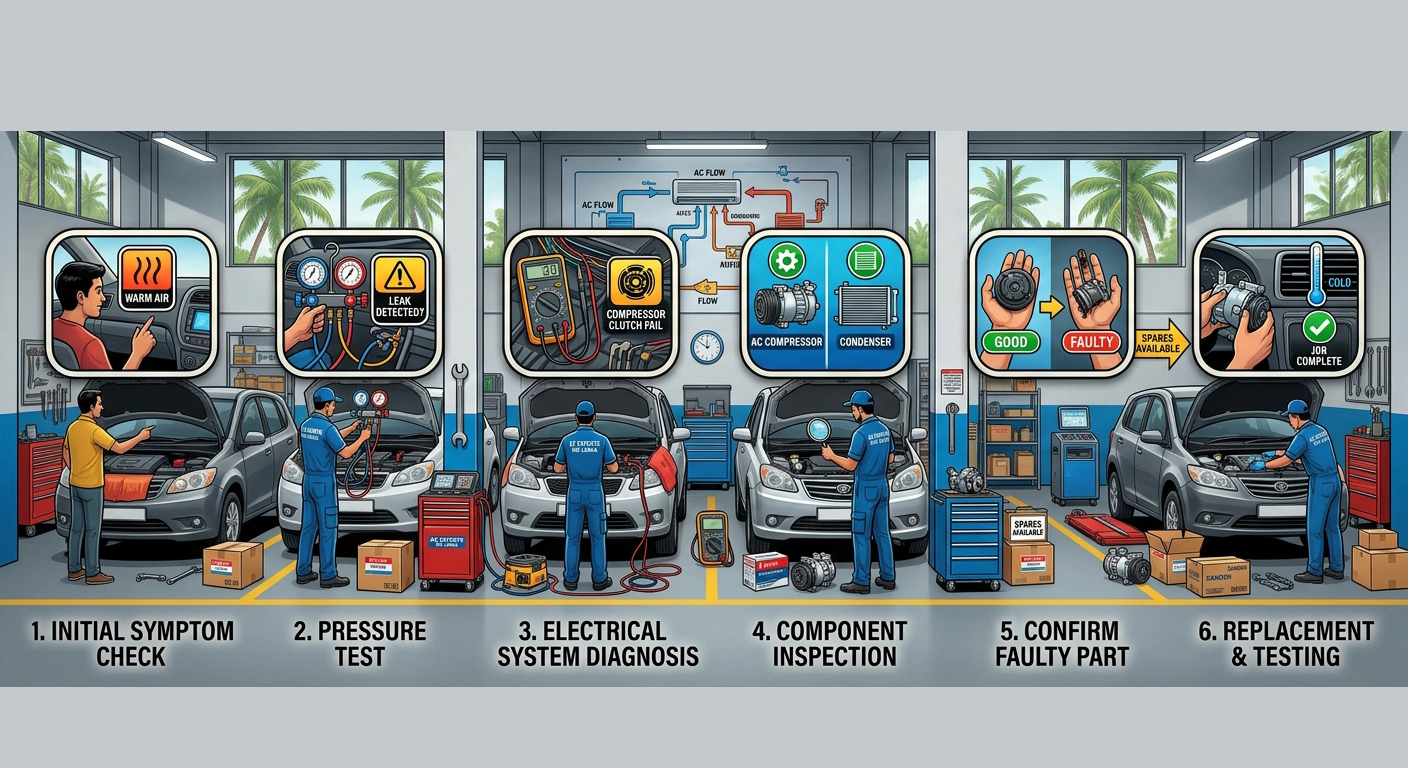
Car AC Spares in Sri Lanka: Diagnose the Fault Before Buying Parts
A car A/C problem often starts with a simple complaint: the air is not cold enough. But that symptom can have several causes. A weak condenser fan, refrigerant leak, clogged cabin filter, faulty pressure sensor, damaged compressor, restricted expansion valve, or electrical problem can all affect cooling.
That is why choosing the right Car AC Spares should start with diagnosis rather than guessing which component has failed.
For vehicle owners and workshops in Sri Lanka, this approach can prevent unnecessary parts replacement, repeated refrigerant charging, additional labour, and damage to newly installed components. Below, we look at the most common A/C symptoms, the parts associated with them, and what should be checked before ordering replacements.
Why Car A/C Problems Are Easy to Misdiagnose
An automotive air-conditioning system is a connected circuit. The compressor, condenser, expansion device, evaporator, fans, sensors, filters, hoses, refrigerant and lubricant all have different jobs, but the performance of one component can affect several others.
For example, a compressor may appear to perform poorly because the refrigerant charge is low. High operating pressure may be related to insufficient airflow through the condenser rather than an internal compressor defect. A vehicle with weak airflow from the vents may have a blocked cabin filter rather than a refrigerant problem.
Compressor manufacturer Sanden specifically advises confirming compressor failure before removal because faults elsewhere in the A/C system can lead to incorrect diagnosis.
The practical lesson is simple: match the symptom to the complete A/C system before purchasing parts.
1. The A/C Blows Air, but It Is Not Cold
This is one of the most common reasons motorists start looking for auto air conditioning parts in Sri Lanka.
However, warm or insufficiently cold air does not automatically mean the compressor needs replacement.
Possible causes include:
- Low refrigerant caused by a leak
- Compressor not operating correctly
- Compressor control-valve problem
- Electrical supply or relay fault
- Pressure sensor problem
- Expansion valve restriction
- Poor condenser cooling
- Condenser fan failure
- Incorrect refrigerant charge
- Air-mixing or climate-control fault
Check for Refrigerant Loss Before Replacing Parts
Refrigerant does not function like fuel that is routinely consumed during normal driving. If the charge has become significantly low, the system should be inspected for leakage.
Possible leak points include hoses, pipe connections, O-rings, service ports, condenser damage, compressor seals and the evaporator.
Simply adding refrigerant may restore cooling temporarily, but it does not repair the source of a leak.
If cooling becomes weak again shortly after a recharge, a leak test is more useful than repeatedly topping up the system.
2. The A/C Is Cold While Driving but Warm in Traffic
This symptom provides a useful diagnostic clue.
The condenser needs airflow to remove heat from the refrigerant. While the vehicle is moving, air naturally passes through the condenser. At low road speed or while stopped in traffic, the system relies heavily on electric fan operation.
If cooling becomes noticeably poorer when stationary, technicians should inspect:
- Condenser fan operation
- Fan motor
- Fan relay or fuse
- Electrical connections
- Fan control system
- Condenser fin condition
- Dirt or debris restricting airflow
- Cooling-system fan operation where fans are shared
Sanden includes condenser and fan failure among system defects that can contribute to compressor problems.
Do Not Ignore a Failed Condenser Fan
Continuing to operate the A/C with inadequate condenser airflow can cause abnormal system pressures and place additional stress on other components.
Replacing a compressor while leaving the actual airflow problem unresolved can therefore result in another expensive failure.
For this symptom, the correct Car AC Spares may be a fan motor, fan assembly, relay, sensor or condenser rather than a compressor.
3. The Air Is Cold, but Very Little Comes Through the Vents
If the air itself is cold but airflow is weak, the refrigerant circuit may be functioning correctly.
Start with the airflow side of the HVAC system.
Inspect the Cabin Air Filter
A heavily restricted cabin filter can reduce the amount of air passing through the ventilation system. DENSO notes that a clogged cabin filter can reduce airflow and HVAC efficiency.
The filter is therefore one of the first items worth inspecting when vent airflow becomes poor.
Other possible causes include:
- Weak blower motor
- Blower motor resistor or electronic controller fault
- Damaged blower fan
- Dirty evaporator
- Air-distribution flap problem
- HVAC control fault
This distinction matters because replacing refrigerant-system components will not correct an airflow restriction.
Signs That Point Toward the Blower System
A blower-related fault becomes more likely when:
- Some fan speeds work but others do not
- The blower operates intermittently
- Airflow is weak at every temperature setting
- The fan makes unusual noises
- Nothing comes from the vents despite the A/C controls being switched on
Electrical testing should be performed before condemning the motor itself because wiring, switches, controllers, relays and power supply can produce similar symptoms.
4. The A/C Makes Noise When Switched On
Unusual noise needs careful attention because there are several rotating components around an automotive A/C system.
Depending on the vehicle, noise may come from the:
- Compressor
- Compressor clutch
- Pulley bearing
- Drive belt
- Tensioner
- Condenser fan
- Blower motor
- Debris trapped in the blower housing
The timing of the noise provides useful information.
If it begins specifically when the compressor engages, the compressor, clutch or drive system deserves inspection. If the noise changes with the interior fan-speed setting, the blower motor or fan is a more likely area to investigate.
Compressor Noise Should Not Be Diagnosed by Sound Alone
Pressure readings, oil condition, refrigerant charge and the state of related components should also be evaluated.
Internal compressor damage can release particles into the refrigerant circuit. When that happens, replacing only the compressor may be insufficient.
Sanden advises flushing contaminated systems following compressor damage and explains that debris can become trapped in modern condenser passages. Depending on the level of contamination and condenser design, replacement may be necessary rather than flushing the condenser.
This is one of the most important considerations when comparing the apparent cost of different A/C repairs.
5. The A/C Works Intermittently
An A/C system that works normally and then suddenly stops cooling can be more difficult to diagnose than a system that never operates.
Intermittent faults can involve:
- Pressure sensors or switches
- Compressor control valve
- Magnetic clutch where fitted
- Relay or electrical connection
- Temperature sensors
- Evaporator temperature control
- Expansion valve behaviour
- Incorrect refrigerant charge
- Excessive system pressure
- Electronic climate-control system
The vehicle should ideally be tested while the problem is occurring. Otherwise, an intermittent electrical component may appear normal during inspection.
Modern Compressors May Not Behave Like Older Systems
Many motorists are familiar with compressors that visibly switch on and off using a magnetic clutch. Not every modern compressor operates that way.
Variable-displacement and electronically controlled compressors can regulate output differently. Hybrid and electric vehicles may use electrically driven compressors rather than conventional belt-driven units.
For this reason, checking whether a clutch appears to engage is not a universal compressor test.
Accurate vehicle identification becomes particularly important before purchasing control valves, compressors or electrical A/C components.
6. The System Was Recharged, but Cooling Failed Again
A recharge can restore cooling when refrigerant quantity is low, but the important question is why the system became low.
If performance deteriorates again, inspect for leakage instead of treating repeated gas filling as the repair.
A proper service may include:
- Identifying the refrigerant specified for the vehicle
- Recovering refrigerant using appropriate equipment
- Checking operating pressures
- Leak testing the system
- Repairing the source of leakage
- Evacuating air and moisture
- Charging the specified refrigerant quantity
- Verifying outlet temperatures and system operation
The exact procedure depends on vehicle and A/C system design.
A New Compressor Can Fail if the Original Problem Remains
A compressor is one of the more substantial purchases among Car AC Spares, so installation should be treated as a complete repair rather than a simple component swap.
Before fitting a replacement compressor, technicians should determine why the previous unit failed.
Possible contributing factors include:
- Refrigerant leakage
- Insufficient or incorrect lubricant
- Contamination
- Condenser restriction
- Poor condenser airflow
- Expansion-device restriction
- Moisture in the refrigerant circuit
- Incorrect installation
- Electrical or control problems
Sanden's technical material identifies low refrigerant or oil, condenser/fan problems, pressure-control faults, expansion-valve restrictions and receiver-drier restrictions among issues capable of affecting compressor operation.
System Contamination Requires Special Attention
If a compressor suffers an internal mechanical failure, particles can circulate into other parts of the system.
Depending on the repair procedure, this can mean checking or replacing additional items such as:
- Receiver drier or accumulator
- Expansion valve
- Condenser
- O-rings and seals
- Refrigerant
- Compressor lubricant
Relevant lines and components may also require approved flushing procedures.
Skipping these steps can turn a replacement compressor into a short-lived repair.
Moisture Is Another Enemy of the A/C System
Automotive refrigeration circuits are designed to operate as sealed systems. Leaving pipes, hoses or components exposed unnecessarily can allow moisture to enter.
Sanden explains that moisture contamination can contribute to corrosion, lubricant deterioration and problems within the compressor and expansion system.
Receiver driers and accumulators contain desiccant intended to manage moisture in the system. Their replacement requirements depend on the repair and vehicle manufacturer's procedures.
This is another reason A/C repairs should not be approached like changing a simple bolt-on accessory.
Why the Correct Compressor Oil Matters
The lubricant inside an automotive A/C system performs a critical role in compressor operation.
It is not safe to assume that all A/C oils are interchangeable.
The required lubricant can vary according to:
- Compressor design
- Refrigerant type
- Vehicle manufacturer
- A/C system specification
- Conventional, hybrid or electric vehicle configuration
Using an incorrect oil type or quantity can affect compressor performance and durability.
DENSO specifically highlights correct compressor-oil selection as an important part of A/C service and notes that electric compressors can require specialised insulating lubricants.
Always confirm the applicable technical specification rather than choosing oil by colour, brand familiarity or what was used on another vehicle.
Buying Car AC Spares: Information to Give the Supplier
Correct identification becomes easier when the supplier receives complete information from the beginning.
Before contacting a parts supplier, prepare:
- Vehicle manufacturer
- Exact model
- Year of manufacture
- Engine capacity or engine code
- Chassis/VIN number
- Existing A/C part number where available
- Photographs of the removed component
- Photograph of electrical connectors
- Compressor pulley details where applicable
- Refrigerant information from the vehicle label
The chassis number can be particularly useful because vehicles with the same model name may use different parts across engine options, manufacturing periods and market specifications.
Never Rely Only on Visual Similarity
An incorrect component may look almost identical to the original part.
Compressors can differ in mounting, pulley specifications, displacement, electrical connections and control valves. Condensers may differ in dimensions, pipe locations or receiver-drier configuration. Expansion valves may have different operating specifications despite similar external dimensions.
Part-number matching and accurate vehicle identification are safer than selecting a component simply because it "looks the same."
Brand-New or Reconditioned Car A/C Parts?
The right option depends on the component, vehicle, budget and condition of the available replacement.
Brand-New Parts
Brand-new components may offer advantages where:
- Long-term reliability is a priority
- Labour to replace the part is substantial
- The vehicle is used heavily
- A known manufacturer or specification is required
- The condition of a used component cannot be verified
Reconditioned Parts
A reconditioned component can be a practical option in some repairs, provided that its condition, compatibility and source are understood.
Before purchasing, establish:
- What has actually been reconditioned
- Whether the component has been tested
- What accessories are included
- Whether there is any applicable seller warranty
- Whether the exact part matches the vehicle
"Reconditioned" should not simply be assumed to mean the same thing as new.
Choosing Auto Air Conditioning Parts in Sri Lanka
For motorists and workshops searching for auto air conditioning parts in Sri Lanka, product availability is only one part of the purchasing decision. Technical fitment support can be just as valuable.
A specialist supplier should be able to work with accurate vehicle information and help identify the required component rather than relying only on a general model description.
MKF Auto Parts currently lists automotive A/C categories including compressors, condensers, evaporators, control and expansion valves, fan assemblies, fan motors, blower motors, receiver driers, cabin air filters and refrigerant-related products. The company also provides vehicle-based parts search through its online catalogue.
A Practical Checklist Before Ordering Any A/C Part
Before spending money on a replacement, work through these steps:
- Confirm the actual complaint. Is the problem temperature, airflow, noise, intermittent operation or complete failure?
- Diagnose before dismantling. Check pressures, leaks, electrical operation and airflow where appropriate.
- Identify the root cause. Do not replace a failed component without asking what caused the failure.
- Record the vehicle details. Use the chassis/VIN, model year and engine information.
- Check the existing part number. Record labels before returning or discarding the old component.
- Confirm refrigerant and lubricant specifications. Do not substitute them based on assumption.
- Check related parts. Compressor failure, contamination or opening the refrigeration circuit may require additional service items.
- Verify what the replacement includes. Sensors, valves, clutches, driers and seals are not always supplied with the main component.
- Use proper installation procedures. Correct fitment is only part of a successful A/C repair.
- Test the complete system afterward. Confirm operating pressures, fan operation, cooling performance and leaks.
Conclusion: Buy the Part That Fixes the Cause, Not Just the Symptom
Finding the correct Car AC Spares begins with understanding what the vehicle is actually doing.
Warm air does not always mean a failed compressor. Weak airflow does not necessarily indicate low refrigerant. Poor cooling in traffic may lead technicians toward the condenser fan and airflow system, while a compressor damaged internally may require much more than fitting another compressor.
Accurate diagnosis, vehicle identification and proper installation therefore matter as much as the quality of the replacement part itself.
For vehicle-specific automotive A/C components in Sri Lanka, prepare the vehicle make, model, year, chassis number and existing part details before contacting a supplier. MKF Auto Parts offers a range of car A/C components for different vehicle applications and provides an online catalogue for identifying available parts.