
When Should You Replace Car Air Conditioning Parts?
A vehicle A/C problem rarely begins with a complete system failure. You may first notice that the cabin takes longer to cool, airflow feels weaker, the A/C works only while driving or an unusual sound appears when the compressor engages.
These symptoms often lead vehicle owners and workshops to search for replacement air conditioning parts. However, replacing a component before identifying the real cause can increase repair costs and leave the original problem unresolved.
This guide explains the warning signs associated with common automotive A/C components, what should be checked before replacement and how buyers in Sri Lanka can order the correct parts with greater confidence.
Repair, Service or Replacement: What Does Your A/C Need?
Not every reduction in cooling means that a major component has failed.
A dirty cabin filter can reduce airflow. A damaged electrical connection can prevent the compressor clutch from engaging. Poor condenser airflow can make the A/C feel weak in traffic. Low refrigerant may indicate a leak rather than a need for repeated recharging.
A professional diagnosis should normally consider:
- Vent temperature
- Refrigerant pressures
- Refrigerant quantity and condition
- Compressor operation
- Condenser fan operation
- Electrical supply and control signals
- Evidence of refrigerant or oil leakage
- Airflow through the cabin filter and evaporator
- Unusual noise or vibration
- Contamination inside the refrigerant circuit
DENSO’s A/C service guidance recommends checking system performance and understanding the vehicle’s recent maintenance history before replacing components. This helps distinguish a failed part from a system-level issue.
Common Air Conditioning Parts and Their Warning Signs
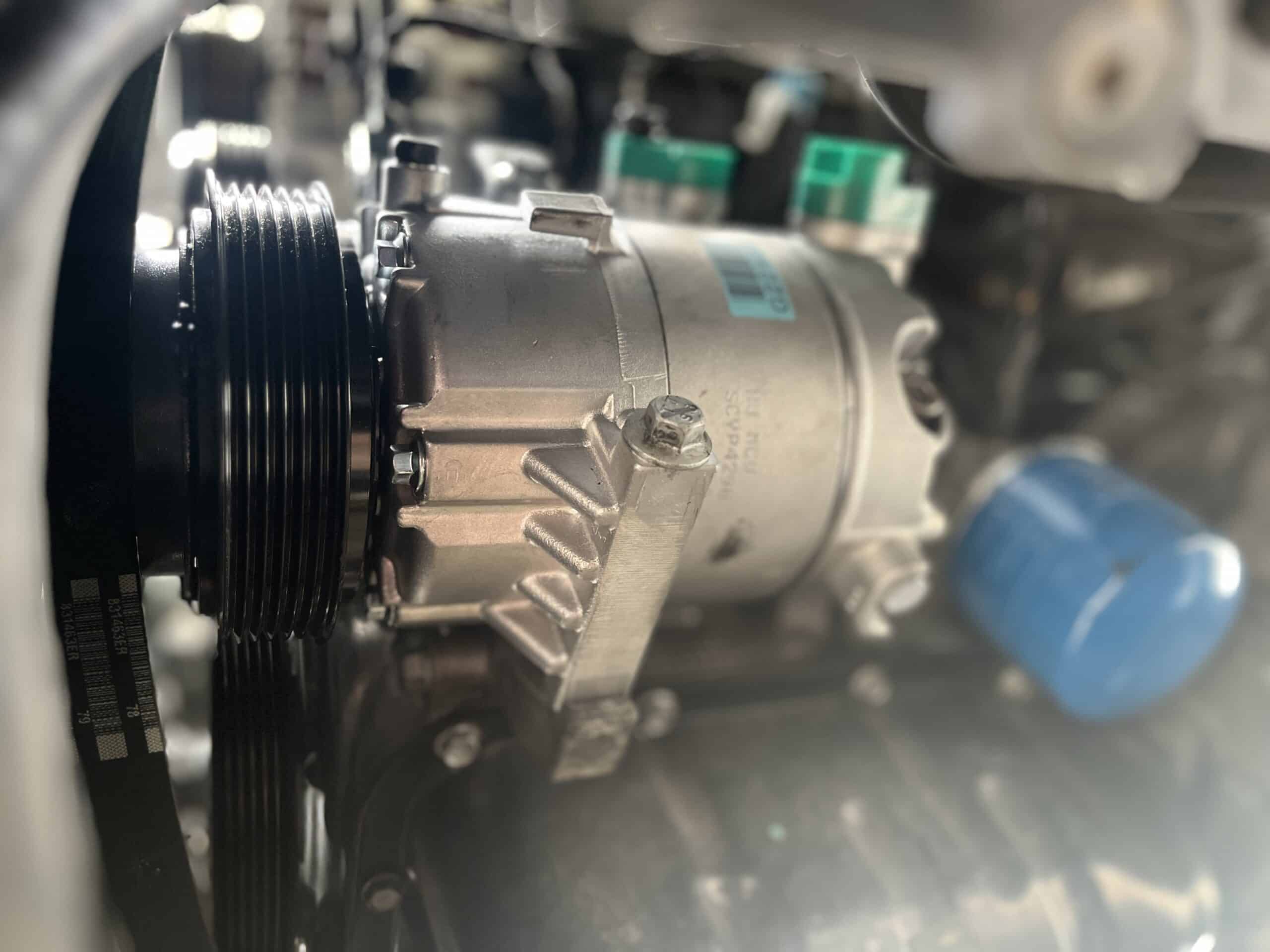
1. A/C Compressor
The compressor circulates refrigerant through the system and enables heat to move from the passenger compartment to the condenser. It is one of the most important and costly automotive A/C components.
Possible signs of compressor trouble include:
Grinding, knocking or rattling sounds
Compressor seizure
Compressor failing to engage
Poor cooling despite a correct refrigerant charge
Metal particles or contamination in the circuit
Visible oil leakage around the compressor
Abnormal high- and low-side pressure readings
These symptoms do not automatically prove that the entire compressor needs replacement. The clutch, pulley bearing, electrical connector, control valve or wiring may be responsible.
Before buying a compressor, ask the workshop to identify whether the fault is mechanical, electrical or hydraulic.
What to Confirm Before Ordering a Compressor
Provide the supplier with:
- Vehicle make and model
- Manufacturing year
- Engine capacity or engine code
- Chassis or frame number
- Existing compressor part number
- Pulley groove count
- Electrical connector photographs
- Mounting-point photographs
- Refrigerant type
- Whether the vehicle is petrol, diesel, hybrid or electric
Two compressors may look almost identical but use different pulleys, connectors, mounting positions or control systems.
2. Compressor Clutch, Pulley and Coil
Many belt-driven compressors use an electromagnetic clutch assembly. When the A/C is switched on, the clutch allows the compressor shaft to engage.
Potential clutch-related symptoms include:
- A click is heard, but the compressor does not turn
- The clutch repeatedly engages and disengages
- The pulley makes noise while the A/C is off
- The clutch slips or becomes excessively hot
- The clutch coil does not receive or hold electrical current
- The compressor works intermittently
Sanden’s troubleshooting guidance identifies issues such as missing voltage, a damaged relay, a burnt clutch coil or an excessive clutch air gap as possible reasons a compressor clutch may not engage.
Replacing only the clutch assembly may be possible on some compressor designs. On others, replacing the complete compressor may be more practical. The correct decision depends on the compressor model, internal condition and availability of compatible service parts.
3. A/C Condenser
The condenser is positioned at the front of the vehicle and releases heat from the refrigerant into the outside air. As heat is removed, the high-pressure refrigerant changes from a gas to a liquid.
Because of its location, the condenser may be affected by:
- Road debris
- Collision damage
- Bent or blocked fins
- Corrosion
- Refrigerant leaks
- Internal contamination
- Poor airflow from a failed fan
Possible warning signs include weak cooling, unusually high system pressure, visible oily marks, cooling that becomes worse in traffic or a refrigerant leak near the front of the vehicle.
Do not assume that every high-pressure problem requires a new condenser. The technician should also inspect the condenser fan, radiator fan, airflow path and refrigerant charge.
Check Whether the Drier Is Integrated
Some condensers include an integrated receiver drier, while others use a separate unit. Buyers should compare the pipe positions, dimensions, brackets, sensor openings and drier configuration before placing an order.
4. Expansion Valve or Compressor Control Valve
The expansion valve controls how much refrigerant enters the evaporator and helps create the low-pressure, low-temperature condition needed for cabin cooling.
A compressor control valve performs a different function. It controls the output of certain variable-displacement compressors.
Possible symptoms associated with valve problems include:
- Cooling that changes without an obvious reason
- Incorrect pressure readings
- Evaporator icing
- Cooling that works intermittently
- Compressor running without producing sufficient cooling
- Temperature changing between vents
Because valve symptoms can resemble low refrigerant, sensor problems or compressor wear, pressure testing and technical diagnosis are important.
When ordering, use the number printed on the valve or compressor wherever possible. Small visual or calibration differences can make a valve unsuitable even when it fits physically.
5. Receiver Drier or Accumulator
The receiver drier or accumulator helps filter debris and manage moisture inside the refrigerant circuit. The component used depends on the design of the A/C system.
A saturated or contaminated drier may contribute to restrictions, moisture-related damage or poor system performance.
Replacement may be considered when:
- The refrigerant circuit has been left open
- The compressor has failed internally
- The system contains contamination
- A major repair is being completed
- The drier is physically damaged or leaking
- The vehicle manufacturer’s procedure requires it
A new compressor should not be installed into a contaminated system without addressing the remaining debris. Sanden warns that contamination left inside the circuit can enter the replacement compressor and cause another failure.
6. Evaporator
The evaporator is normally installed inside the HVAC housing behind the dashboard. Air passes across its cold fins before entering the cabin. The evaporator absorbs heat from that air while the refrigerant changes state.
Possible evaporator problems include:
- Refrigerant leakage inside the HVAC housing
- Uneven cooling
- Evaporator icing
- Musty odours
- Restricted airflow from dirty fins
- Water entering the cabin because of drainage problems
A bad smell alone is not enough to confirm evaporator failure. The cabin filter, evaporator surface and drain tube should also be checked.
Replacing an evaporator may require significant dashboard disassembly. Accurate part matching is especially important because ordering the wrong unit can delay a labour-intensive repair.
7. Blower Motor and Condenser Fan Motor
The blower motor pushes conditioned air through the vehicle’s vents. The condenser fan helps move outside air through the condenser, particularly when the vehicle is stationary or travelling slowly.
Signs of a Blower Motor Problem
- Little or no air from the vents
- Airflow works only on certain speed settings
- Squeaking or rubbing sounds behind the dashboard
- Intermittent vent airflow
- Blower stops after running for a period
The blower resistor, controller, fuse, relay and wiring should also be checked.
Signs of a Condenser Fan Problem
- A/C works while driving but becomes warm in traffic
- System pressure rises while the vehicle is stationary
- Fan does not operate when required
- Cooling improves when road speed increases
- The fan makes excessive noise or turns slowly
These symptoms can help direct the diagnosis, but electrical testing is necessary before ordering a motor or complete fan assembly.
8. Cabin Air Filter
The cabin filter is one of the simplest air conditioning parts, but it can significantly affect how the system feels to the driver.
Its purpose is to reduce dust and other particles entering the cabin through the ventilation system.
A filter may need attention when:
- Vent airflow has become weak
- Dust appears around the vents
- The blower sounds strong but little air enters the cabin
- The filter is visibly dirty or damaged
- An unpleasant smell appears when the fan starts
- Replacing a restricted filter may restore airflow, but it will not solve a refrigerant or compressor problem.
9. Hoses, Pipes, O-Rings and Seals
Refrigerant can escape through damaged hoses, loose connections, aged O-rings, compressor shaft seals or corroded pipes.
Possible signs include:
- Oily residue around a connection
- Repeated loss of cooling
- Refrigerant charge lasting only a short period
- Visible cracks or damage to a hose
- Leakage detected using appropriate equipment
A leaking seal may be inexpensive compared with a major component. However, the system should be inspected carefully because oil marks can travel and may not identify the exact source.
Match the Symptom to the Area That Needs Inspection
The following examples can help buyers communicate with a technician or air conditioning parts store.
The A/C Is Cold While Driving but Warm in Traffic
Inspect the condenser fan, fan motor, fan relay, condenser airflow and system pressures.
The Blower Is Noisy but Airflow Is Weak
Inspect the cabin filter, blower wheel, evaporator surface, air ducts and blower motor.
The Compressor Does Not Engage
Inspect the fuse, relay, clutch coil, electrical supply, pressure sensor and control system before replacing the compressor.
The New Compressor Failed Quickly
Investigate contamination, insufficient lubrication, incorrect oil, system restriction, poor condenser performance or an unresolved installation problem.
Cooling Disappears Shortly After Recharging
Test for refrigerant leakage rather than repeatedly adding more refrigerant.
Mistakes to Avoid When Buying Replacement Parts
Ordering by Vehicle Name Alone
“Toyota compressor” or “Honda condenser” is not enough information. The same vehicle model can use different parts depending on the engine, year and production specification.
Replacing the Compressor Without Finding the Cause
Compressor damage may be the result of contamination, poor lubrication, a blocked circuit or excessive pressure. Installing another compressor without correcting the cause can lead to repeated failure.
Using the Wrong Refrigerant or Compressor Oil
Automotive refrigerants and oils are not universally interchangeable. DENSO notes that the correct oil is important for compressor lubrication and heat transfer.
Use the vehicle identification label and approved technical data. Refrigerant should be recovered and handled with suitable professional equipment rather than intentionally released.
Assuming Every Included Part Is the Same
Ask whether a compressor includes the clutch, pulley, control valve, oil or seals. Ask whether a condenser includes the receiver drier. Product packages can differ.
Ignoring New Versus Reconditioned Condition
Both new and reconditioned components may be available. Ask how the part was tested, what is included and what warranty or exchange terms apply.
Finding an Air Conditioning Parts Store in Sri Lanka
MKF Auto Parts focuses on automotive A/C components for vehicle owners, workshops and distributors. Its stated range includes compressors, condensers, evaporators, clutch coils, valves, receiver driers, hoses, blower motors and filters. The company also states that island-wide delivery is available.
The online catalogue allows buyers to review products by vehicle and component category. MKF lists its physical location at No. 524C, High Level Road, Nugegoda, Sri Lanka.
Before visiting or ordering, send:
- The vehicle model and year
- Engine and chassis details
- The old part number
- Clear photographs
- Workshop diagnosis
- Preferred new or reconditioned condition
- Delivery location
This information makes it easier for the supplier to check availability and compatibility.
Frequently Asked Questions
How do I know which car A/C part has failed?
Start with a complete diagnosis. Cooling problems may come from refrigerant leaks, electrical faults, airflow restrictions, valves, sensors, fans or the compressor.
Can I replace only the compressor clutch?
It may be possible on certain compressor models. The pulley, bearing, coil and internal compressor condition should be inspected before deciding between clutch repair and complete compressor replacement.
Why does my car A/C work only when the vehicle is moving?
A condenser airflow problem is one possible cause. Check the condenser fan, fan motor, relay, blocked fins and system pressure.
Should the receiver drier be replaced with the compressor?
It may be recommended when there is contamination, the system has been left open or the compressor has failed internally. Follow the component and vehicle manufacturer’s repair procedure.
What information should I send to an air conditioning parts store?
Send the vehicle make, model, year, engine information, chassis number, existing part number and clear photographs of the component.
Where can I buy automotive air conditioning parts in Sri Lanka?
MKF Auto Parts supplies automotive A/C components from its Nugegoda location and states that island-wide delivery is available. Contact the supplier with complete vehicle details before ordering.
Replace Air Conditioning Parts with the Right Information
Selecting automotive air conditioning parts should begin with diagnosis, not guesswork. A weak fan, clogged filter, damaged seal or faulty clutch can sometimes produce symptoms that appear to indicate a more expensive compressor problem.
Confirm the cause, record the existing part number and provide accurate vehicle information before purchasing. Buyers looking for an automotive air conditioning parts store in Sri Lanka can explore MKF’s product range or contact its Nugegoda team for availability and fitment assistance.